Every contract and relationship in the coffee world relies on a complex logistics process that gets coffee from its source to its destination. This past year, with changing tariffs, crowded ports, and new regulations, that job has become more important and more difficult than ever.
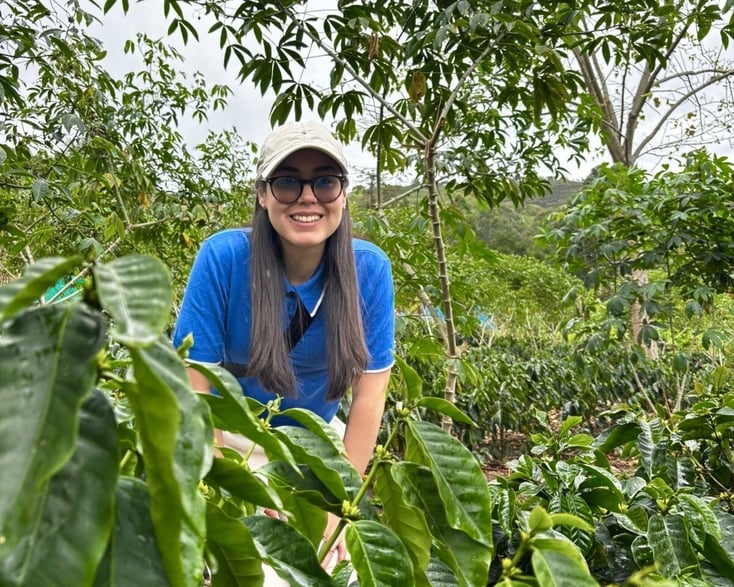
In this edition of our series “The People Behind Relationship Coffee,” we talked with Angie Alvarez, Sustainable Harvest’s Traceable Logistics Supervisor. Angie has experience in global trade, oil and gas, and international organizations. After a little over a year working in coffee logistics, she offers a unique view that combines precision, adaptability, and a strong respect for the people in the supply chain.
Read the full Q&A with Angie to learn how handling unpredictable shipping and seeing the effects of long-term producer relationships show that logistics powers relationship coffee every day.
________________________________________________
Sustainable Harvest (SH): Angie, let's start from the beginning. What did you study, and how did you end up working in logistics?
Angie Alvarez (AA): I studied International Business, then completed a specialization in Logistics Management and later a master’s degree in Supply Chain Management. I’ve also studied customs regulations in several countries, especially across Latin America and the United States.
My background has always been in logistics and international trade. I actually started my career at a freight forwarding company, where I did my internships. From that point on, I’ve always worked in logistics.
What attracted me most was being part of a global chain. Logistics connects countries, industries, and people. It’s not limited to one place or one product; it’s about interconnection. That global dimension really drew me in, and I stayed.
SH: Before joining Sustainable Harvest, you worked in other industries, including oil and the United Nations. What was that journey like?
AA: Yes, I started on the service-provider side in freight forwarding and later moved to the client side. That gave me two perspectives: I understand logistics both as a provider and as a company hiring those services.
I then joined a US-based oil company with operations across Latin America. I began coordinating sales and operations for the Andean region (Ecuador, Peru, and Colombia) and eventually became Logistics Manager for Latin America. My work included imports, exports, inventory management, supplier payments, and developing logistics strategies that created financial efficiencies.
After that, I worked for the International Organization for Migration (IOM), part of the United Nations system. That was a completely different experience, logistics focused on moving vulnerable populations, managing airport operations, documentation, and reporting. It shifted my mindset toward sustainability and social impact.
When I saw the opportunity at Sustainable Harvest, the profile matched what I had done my entire career, only now in coffee. It felt like the perfect combination of logistics expertise and meaningful impact.
SH: What convinced you to join Sustainable Harvest, especially since coffee was a new industry for you?
AA: First, the opportunity to learn. While logistics principles remain the same, every industry is different. Coffee has its own complexities.
What really stood out to me was that Sustainable Harvest doesn’t focus only on profitability; it also prioritizes producers and long-term sustainability. That balance between business and impact was very attractive! I was also drawn to the company culture. There is strong female leadership and visible empowerment at high levels of the organization. That cultural fit mattered to me.
SH: After a year in coffee logistics, especially during such a volatile year, what has kept you motivated?
AA: 2025 was incredibly dynamic. Trade tensions, tariffs, shifting regulations, port congestion, almost every month, something changed. And because we import primarily into the U.S., political decisions directly affect our work.
Logistics may not always be the most visible role, but it’s the department that makes everything happen. Contracts can be signed, but if coffee doesn’t ship, clear customs, and arrive on time, nothing else matters.
That responsibility keeps me motivated. Every day you learn something new, and you know that your work directly ensures that commitments are fulfilled across the supply chain.
SH: From your perspective, what differentiates Sustainable Harvest from other companies?
AA: It’s definitely the focus on sustainability and long-term relationships.
In many industries, suppliers are treated transactionally. Here, producers are strategic partners. I saw that clearly during my first trip to origin after Let’s Talk Coffee [Lima, Peru 2025]. The company genuinely cares about producers’ realities – the climate challenges, infrastructure limitations, social pressures, etc. – and works alongside them.
I’d say that the relationship-based model is what makes Sustainable Harvest both impactful and commercially successful.
SH: After visiting origin, what impacted you the most?
AA: Seeing firsthand the challenges producers face, climate variability, transportation barriers, social disruptions, and yet their deep commitment to fulfilling their contracts.
Coffee is often a family effort. Entire households are involved, and there is a strong desire to improve quality of life and create opportunities for the next generation. Hearing about young people leaving and then returning to coffee because it’s becoming more professional and viable was powerful.
It gave deeper meaning to the logistical challenges we navigate every day.
SH: What do you wish roasters and suppliers understood better about logistics?
AA: That there are factors completely outside our control.
Port congestion, container shortages, shipping line cancellations, customs system outages, documentation delays, these things happen globally and often without warning. We always communicate transparently, but some delays are simply unavoidable.
Understanding that complexity and the constant problem-solving happening behind the scenes would go a long way.
SH: If you could speak directly to a roaster or producer considering working with Sustainable Harvest, what would you tell them?
AA: To a roaster, I would say: you can trust the integrity of the supply chain. Producers and cooperatives are carefully selected, quality standards are high, and transparency is maintained throughout the entire process.
To a producer, I would say: Sustainable Harvest is not just another buyer. It’s a long-term ally. That makes a big difference.
SH: One last question! I know you don't drink coffee, but you've been learning to cup. Has anything surprised you?
AA: I’ve had a couple of cupping sessions, and while I can’t drink much coffee due to medical reasons, I’ve learned a lot.
There was one coffee from Cauca, Colombia, that really surprised me. It tasted completely different from what I expected; complex, expressive, memorable. That was the moment I understood why people become so passionate about specialty coffee.
Even if I can’t drink it daily, I’ve definitely developed a new appreciation for it.

.png "SH Logo")