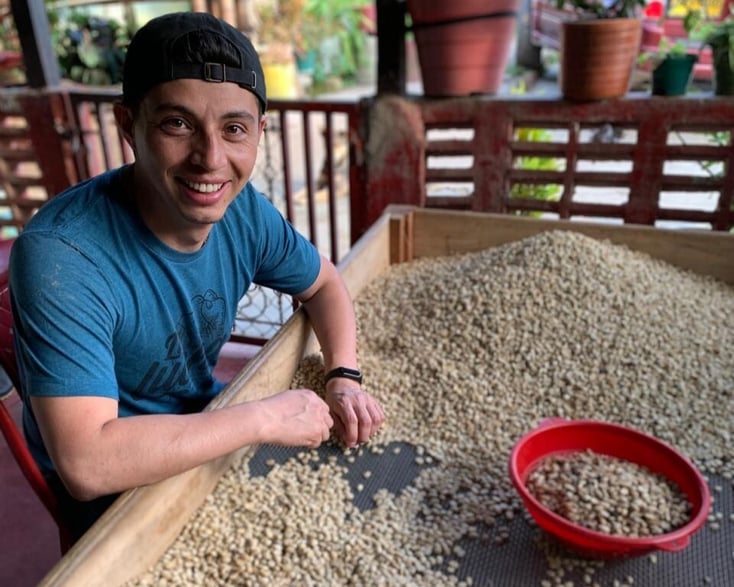
Leonardo “Leo” Acosta’s path into coffee began with a simple sign in a café window.
Just after finishing university and looking for his next step, Leo took a chance on a part-time job at a small café in downtown Bogotá. That first role quickly opened doors to barista competitions, professional training, and a career that has touched nearly every part of the coffee supply chain.
Today, we’re proud to have Leo as part of our Traceable Logistics Inbound team at Sustainable Harvest, where he helps to ensure that coffee moves smoothly from origin to roasters worldwide. In this Q&A, Leo shares how his curiosity, the guidance of mentors, and his love of learning have shaped his journey from the espresso bar to global coffee logistics, and why, for him, relationships are always at the center of what we do.
________________________________________________
Sustainable Harvest (SH): Leo, we know you have a very interesting background in coffee and that you have worked in different roles across the supply chain! How did you first get into coffee?
Leo Acosta (LA): I actually came into coffee almost by accident. I studied hospitality management in Bogotá, and when I graduated, I needed to start working right away because I had a student loan to pay off.
At the time, I was very young, and finding a job was difficult. One day, I was walking through downtown Bogotá and saw a small café with a sign looking for a part-time employee. I applied, even though I had zero experience with coffee.
A couple of weeks later, the person who was in charge of preparing the coffee quit. The owner asked me if I knew how to use the espresso machine. I told her I could learn. She gave me the chance, and that’s how I started preparing coffee, and even roasting it.
At the beginning, it was very basic. I was told things like: “Roast one kilo at this temperature and take it out when the timer goes off.” There was no explanation about roast curves or flavor development. I was just following instructions without really understanding what was happening.
SH: When did coffee become something more than just a job?
LA: A few months later, a consultant came to the café to give training. That consultant was Claudia (Claudy Gomez), who later became a very important mentor in my career.
She showed us presentations about coffee, origin, processing, brewing techniques, and everything behind what we were serving. That was the moment when I realized that coffee was much bigger than what I was seeing in that café.
I became fascinated. I started watching videos online and trying to replicate what I saw, even recording tutorials on my phone so I could watch them again while working.
Not long after that, my managers asked if I wanted to compete in a barista championship. At first I said no because I had only been working with coffee for a few months. But they encouraged me and sent me to train professionally.
SH: And that competition ended up being a big moment for you, right?
LA: Yes, it changed everything! I trained for about six months, almost every day. We even worked on things like breathing techniques and stage performance, because competitions are not just about making coffee; they’re also about how you present it.
I was incredibly nervous. During the competition, I even burned my hand with milk right before my presentation.
But when I stepped on stage, something interesting happened: the pressure helped me focus. I completed my routine, and when the results were announced, I ended up finishing second place nationally.
The crazy part is that I had only been working in coffee for about seven months.
That moment made me realize that coffee could be a real career for me.
SH: What happened after that competition?
LA: After that, I continued developing my career in coffee. I worked for seven years at another café, where I focused heavily on barista training.
Later, I moved to work with an exporter, where I specialized more in cupping and roasting.
Over time, I kept in touch with Claudia, and in 2018, I was ready for a change in my life. I told her I wanted to explore opportunities outside Colombia.
She called me one day and said she had a job opportunity, but it was far away. When I asked where, (jokingly) she said “Russia.”
I said yes immediately!
Then she laughed and told me the position was actually with Sustainable Harvest. She had recommended me for the role, and they had approved bringing me onto the team.
That’s how I joined the company in 2018 as Coffee Quality Control in Colombia.
SH: You had already been connected to Sustainable Harvest before joining the team, right?
LA: Yes! My first connection to the company actually came through Let’s Talk Coffee.
I volunteered at three events over the years. I was always impressed by the company's vision. It felt innovative and very focused on building relationships in the industry.
At the time, I remember thinking, “It would be amazing to be part of this company someday.”
It took almost ten years from my first volunteer experience to actually joining the team.
SH: You started in quality control, but how did you transition into logistics and operations?
LA: For my first several years at Sustainable Harvest, I focused primarily on coffee quality and sample management.
A couple of years ago, my role shifted toward traffic and logistics, which was a big adjustment for me at first. I remember telling Claudia that I wasn’t sure I would be able to do it because it felt like learning a completely new language.
Today, my work focuses mainly on coordinating shipments with exporters around the world. My role is to communicate with producer organizations and exporters, send shipping instructions, collect export documentation, and make sure everything is prepared for the coffee to leave origin.
Once the coffee is on the water, other members of the team handle customs and arrival logistics at destination.
It’s a lot of coordination, but it’s also very rewarding to see everything come together.
SH: What has been the most rewarding part of your time at Sustainable Harvest?
LA: Earlier in my career, one of my favorite things was visiting origin and working directly with producer groups. I really enjoyed teaching and sharing knowledge about coffee.
Today, my role is different, but I still find satisfaction in another way.
For example, when we start the harvest season we often have a long list of containers that need to ship. Seeing that list gradually disappear, knowing that we successfully moved all those coffees to market, is incredibly satisfying.
It’s a different kind of impact, but it still connects back to the same purpose.
SH: What do you think makes Sustainable Harvest different from other companies?
LA: For me, the biggest difference is relationships.
Inside the company, we operate like a family. Many of us have worked together for years, even across different offices around the world, and the “being a family” feeling is very real!
But that same philosophy extends to the people we work with, producers, exporters, and roasters.
Transparency is also very important. When we sit down to do business, the goal is to be clear and honest about the reality of the market and the value of the coffee.
And you can see the results of that approach in the longevity of our relationships. Many of our partners have been working with Sustainable Harvest for many years.
SH: What are some of the biggest challenges you face in your current role?
LA: One of the biggest challenges is understanding different cultures and working styles across coffee origins.
For example, every country has its own harvest schedule, holidays, and ways of communicating. Sometimes people expect a shipment to happen immediately, but the reality is that producers or exporters might be observing national holidays or working within a different timeline.
Communication styles also vary a lot between regions. In some places, you need to communicate in a very specific way to get a response.
A big part of my job is learning how to navigate those differences so we can keep everything moving.
SH: After nearly two decades in coffee, do you have a favorite coffee?
LA: Honestly, I don’t think I have a single favorite coffee.
Coffee is very connected to moments and experiences. The same coffee can taste different depending on where you are and who you’re sharing it with.
But if I had to choose a “go-to,” I would probably say coffees from southern Colombia, like Huila or Cauca.
As for brewing, I usually drink about one liter of coffee a day, and my favorite method is French press, although I also enjoy pour-over.
SH: Finally, after all these years in the industry, what keeps you passionate about coffee?
LA: For me, it’s the people! Coffee is a business, of course, but at the end of the day, it’s also about relationships and helping others succeed.
When you see a producer who needs support and you’re able to connect them to the market or help move their coffee, that’s incredibly rewarding.
I think that’s also the spirit behind Sustainable Harvest from the beginning: building relationships that help people grow.
And that’s what continues to motivate me every day.

.png "SH Logo")