.jpg?width=734&height=524&name=PHOTO-2024-05-24-15-14-10%20(1).jpg)
For more than five decades, Cooperativa La Prosperidad de Chirinos has been building a model rooted in quality, collaboration, and long-term impact in northern Peru. What began in 1968 as a small group of producers coming together to overcome remote locations and challenging logistics has grown into a cooperative that today supports hundreds of farming families across the regions of San Ignacio and Jaén.
In this Q&A, we spoke with Michael Montalván, General Manager of La Prosperidad de Chirinos, about the cooperative's history, its focus on quality and sustainability, and the programs that are shaping its future – from youth education and women's leadership to research plots and climate resilience. Michael also shares his own journey within the cooperative and reflects on how mindset, reinvestment, and relationships have helped Chirinos continue to grow, generation after generation.
________________________________________________
Sustainable Harvest (SH): Before we dive deep into what La Prosperidad de Chirinos does, tell us a bit about yourself. What is your role in the cooperative, and how did you become General Manager?
Michael Montalván (MM): I was born in Chirinos. My father was a teacher, and my mother worked in the fields with my grandmother, who was a coffee farmer. I didn't really understand the cooperative movement until my university years. I studied Business Administration in Chiclayo, and when I returned, I had the opportunity to begin working at Chirinos.
I started in the “production and collection area”, which was the department responsible for registering members’ coffee deliveries, tracking volumes and quality, and managing the documentation required for certifications; then I moved to traceability, later to administration and finance, and seven years ago, I became General Manager. I was 27 when I took the position. I've now been with the cooperative for nearly 12 years, and almost all my professional experience has been in coffee.
SH: Now tell us a little about La Prosperidad de Chirinos. We know the cooperative has been operating for more than 50 years. What's the story behind it?
MM: La Prosperidad de Chirinos was founded in 1968 by a group of about 30 producers. They had previously belonged to a cooperative in San Ignacio, but due to the distances [between farms] and logistics [challenges], they decided to create their own organization.
Today, we work with more than 814 producer families located across the provinces of San Ignacio and Jaén, and the cooperative has a production capacity of more than 150 containers.
Over the years, we've gone through cycles of growth and challenges, always guided by our core vision: improving the quality of life for producers. Our motto is "quality coffee, quality of life," and our work combines sustainable production, access to health and education, quality-based premiums, and responsible agriculture.
We also partner with universities such as the National University of Jaen (UNJ) and the Universidad Toribio Rodríguez de Mendoza, here in Peru, to promote research projects and programs that support generational renewal* in coffee production.
SH: How do these university programs work? Are participants the children of members?
MM: Yes, mainly the children of members. They apply to the universities through a special admissions track for agricultural cooperatives. Thanks to this agreement, we now have 48 sons and daughters of members attending university.
The cooperative supports them with enrollment fees and also offers educational loans to their families. We hope that once they graduate, they can find opportunities within the cooperative or elsewhere in the coffee industry, as the majors they typically choose are coffee-related, such as agronomy, business administration, and fields related to agriculture.
Before signing this university agreement, we also ran the "Inspire Program," developed with some financial partners, which offered career guidance and introduced high school seniors to the cooperative model. The goal was to encourage them to remain in the coffee sector and believe in cooperativism.
SH: You also have a very strong women's program! How do the Women Coffee Growers Committee and the Cosecha de Mujer (Women's Harvest) programs work?
MH: The Women Coffee Growers Committee is a very active group within the cooperative. Thanks to partners, including Sustainable Harvest, we've launched projects that create additional income opportunities for female members.
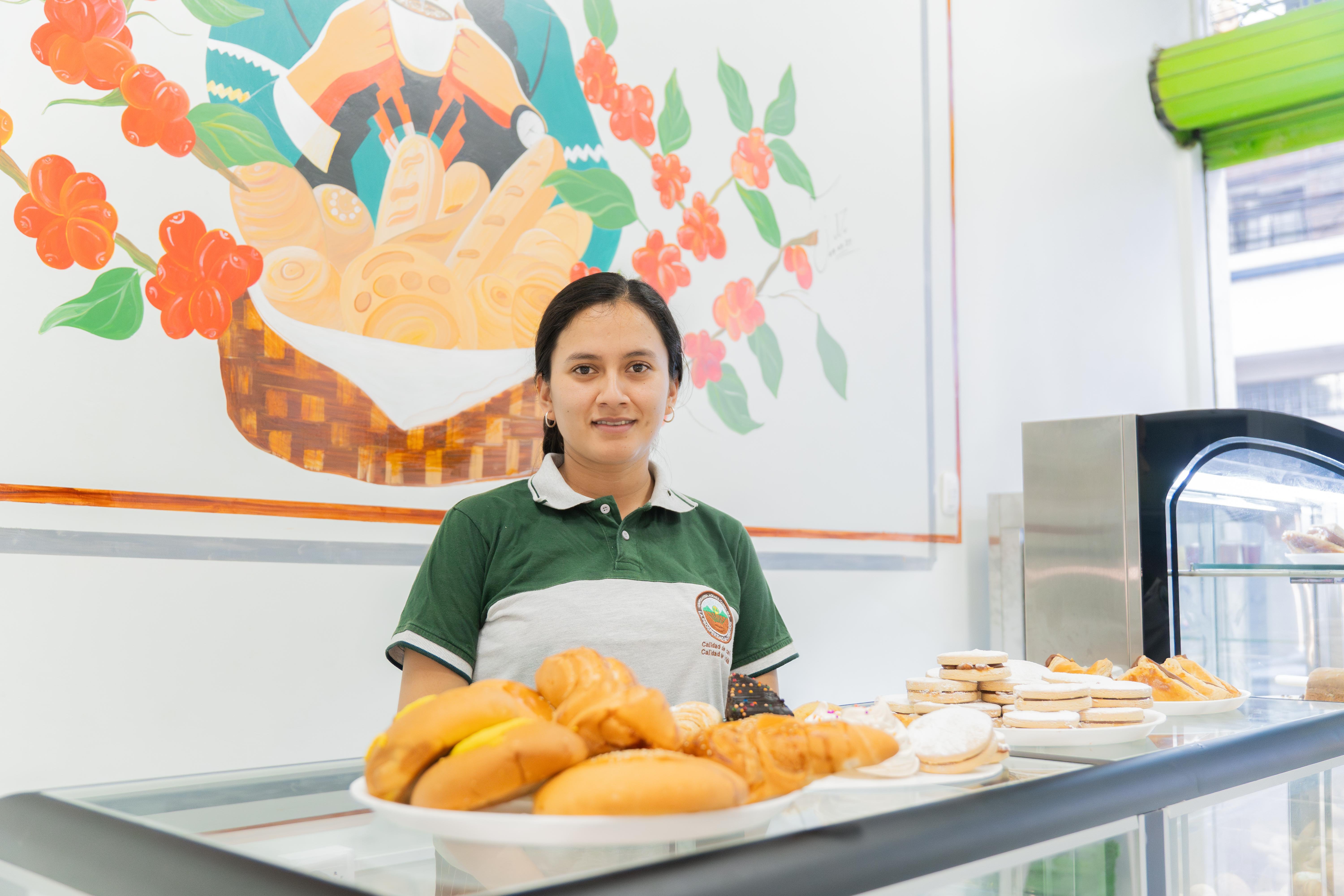
One of the most important initiatives is Cosecha de Mujer, through which we provide a premium of USD 5 per quintal (46 kg / 101 lbs of green coffee). With that fund, the women were able to create and equip a bakery in Jaén, which they manage directly. It has been a truly inspiring project!
Today, we have 223 women members, which is about 28% of our total membership.
SH: With so many programs, you must have seen a lot of change in the past five years. What transformations do you see in producers that works with Chirinos?
MM: The biggest change has been in mindset. Within the Women's Committee, leadership and participation have grown significantly, and cooperative law now requires gender representation in committees and the board of directors, which has also been key.
Chirinos was a pioneer in implementing drying modules**, technical fertilization***, and variety selection in the region.
With quality incentives, producers have reinvested more in their farms. That reinvestment has been essential. Producers are no longer thinking only about volume; they're thinking about specialty, differentiation, and sustainability.
Today, around 20% of our production qualifies as specialty coffee (84+). It's been a very positive evolution.
SH: We know you also have demonstration plots, where you experiment with varieties and different processes. Can you tell us about them and how this approach helps reduce risk and strengthen learning from producers?
MM: That's exactly the idea. Demonstration plots, which we call “Centers of Excellence,” allow producers to learn by doing and by seeing real results. Instead of asking them to take a risk on their own farms right away, we test new practices, varieties, and systems in controlled environments that reflect the realities of each zone, such as altitude, climate, and production conditions.
On the processes side, this is still very new to us; we're still learning! So, for now, we're working with small volumes. We started experimenting in our demonstration plot to understand processing better, and slowly, some producers are now creating microlots.
Producers can see what works, understand why it works, and then decide how and when to apply it on their own farms. That significantly reduces risk and builds confidence.
We're also investing time and effort in agroforestry systems. Every year, we provide between 7,000 and 10,000 seedlings free of charge so producers can renew their farms, add shade to their farms or reforest certain areas. This helps protect the environment while also improving farm resilience and long-term productivity.
Our goal is to improve productivity at the farm level, so production can be more efficient and quality improves too. And with better quality comes more stable and sustainable income, which directly impacts quality of life.
Education is at the center of all of this. We've learned that "we must educate before we harvest." Producers need training not only to improve their farms but also to become leaders; people who can take on decision-making roles within the cooperative and help guide its future sustainably.
SH: What have been the biggest challenges for Chirinos in the last five years?
MM: One of the biggest was the pandemic. It pushed us to create new collection strategies, including farm pick-up services and decentralized collection centers.
Another ongoing challenge is climate change. It has increased pest pressure (like coffee borer), reduced yields, and raised production costs.
To address this, we’ve strengthened technical assistance and implemented our 17 demonstration plots, where lead producers teach others using farmer-to-farmer methodologies, always based on agroforestry systems.
%20(1).jpg?width=734&height=551&name=Imagen%20de%20iOS%20(1)%20(1).jpg)
SH: Is there a success story you'd like to highlight?
MM: For us, success is collective! Our social focus is strong: 70–80% of our staff are children of cooperative members.
We also organize internal competitions and support direct microlot exports for standout producers, charging only operational costs and passing along all premiums to them.
When one producer succeeds, others say, "If they could do it, so can I," and that creates a virtuous cycle.
SH: Finally, what's ahead for the future of Chirinos?
MM: We're focused on three main areas: productivity and quality through climate-resilient plots; Regenerative Organic Agriculture, with a pilot of 300 producers; and social and educational strengthening, continuing programs for youth, women, and producer-leaders.
We're also consolidating Multiservicios Chirinos, the cooperative's service business that supports smaller organizations that don't have access to markets or financing.
We want Chirinos not just to reach 50 more years, but to build a 100- or 120-year legacy for future generations.
__________________________________________
*Generational renewal: refers to the process of encouraging and supporting younger generations to stay involved in agriculture by creating real opportunities for them to learn, lead, and build a future in the sector.
**Drying modules: coffee drying units designed to give producers greater control over the drying process after harvest. These modules can include raised beds, covered drying structures, or modular drying systems that protect coffee from rain, excessive humidity, and sudden temperature changes.
***Technical fertilization: data-driven and site-specific approach to fertilizing coffee farms, where inputs are applied based on soil analysis, plant needs, altitude, variety, and local growing conditions rather than using generalized or uniform formulas.

.png "SH Logo")