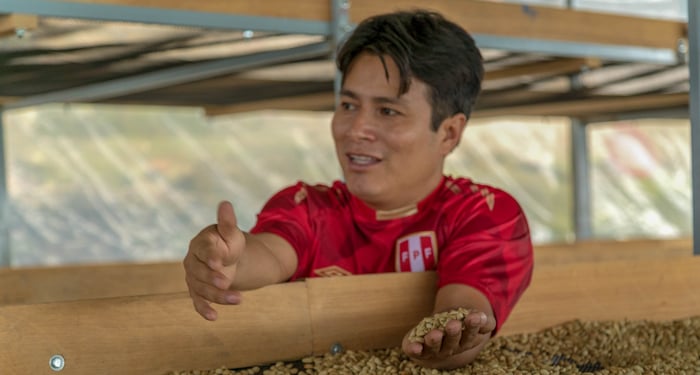
Finca Churupampa, in Chirinos, Cajamarca – one of our Peruvian partners since 2017 – has built an unrivaled reputation for quality Peruvian coffee. Their journey didn’t begin with a new certification or a market trend; it began with long-term thinking about a harder problem: How could coffee remain viable for producers facing climate change, rising costs, and volatile markets without transferring more risk onto farming families?
Eber Tocto and his family (the team behind Churupampa) have spent years improving coffee production while caring for the land. What began with efforts to recover soil health evolved into a more technical production model – one that combines organic practices with higher productivity, lower production costs, and a strong focus on farmer profitability.
In this Q&A, we spoke with Eber about Churupampa’s journey. From soil recovery and regenerative organic production to farmer profitability, education, and the importance of relationships in creating lasting change.
________________________________________________
Sustainable Harvest (SH): Tell us a little about Finca Churupampa!
Eber Tocto (ET): Finca Churupampa is a family business. Coffee has always been connected to our family and our land. I was born on the farm, and today I continue working to improve it and make it more productive.
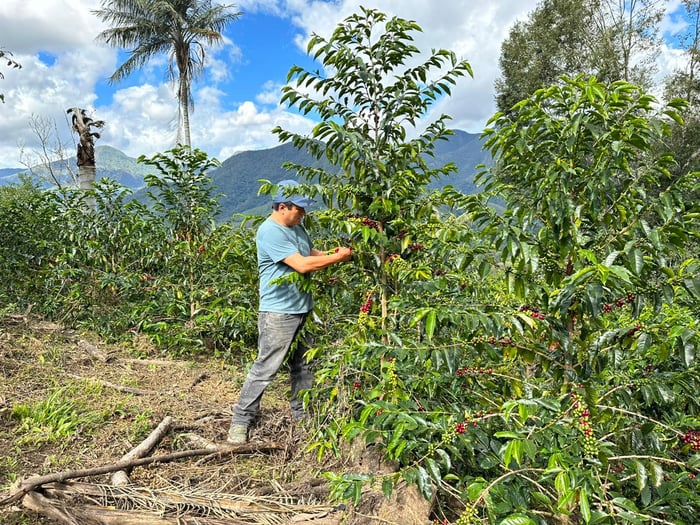
Finca Churupampa isn’t just a single farm. We actually have several farms spread out at different elevations, from about 1,400 up to 1,800 meters above sea level. Over the years, we’ve spent a lot of time learning how to make each farm more productive, all while making sure we’re caring for the soil and the environment.
For us, that has meant changing the way we produce coffee. We started working with organic matter and soil recovery years ago, and in 2020 we decided to introduce a more technical production model…[to] increase productivity and reduce production costs while continuing to work organically.
We decided to take the risk ourselves first. We implemented the model on our own farms, learned what worked and what didn't, and then started sharing what we learned with other producers.
That has become a very important part of what we do at Finca Churupampa. We don't just want to produce good coffee ourselves. We want to show other producers that it is possible to make their farms more productive and profitable while taking care of the soil.
Today, we work with around 500 producers, and approximately 240 of them are already implementing the technical production model [at varying scales].
For me, one of the most rewarding things is seeing what happens when producers begin to see their farms differently. They start investing in their farms, improving their homes, educating their children, and thinking about coffee as a real business and a profession.
That is what we are trying to build at Churupampa: not just better coffee, but more productive farms, healthier soils, and better opportunities for the families who depend on coffee.
SH: What led you to rethink your production model?
ET: Several years ago, we were concerned about two major issues.
The first was climate change. Many producers were farming at 1,200–1,300 meters above sea level, and we didn’t know what the future would look like for those [more vulnerable] farms.
The second was the market. We saw roasters struggling when prices rose, while producers were dealing with extremely low yields, sometimes only 8 quintals per hectare - around 368 kg / 811 lbs. (1 quintal = 46 kg / 101 lbs. of green coffee)
Even we, who were among the more professionalized producers in the area in 2018, were harvesting around 35 quintals per hectare – around 1.7 tons. And still, profitability was minimal. You didn’t lose money, but margins were very small.
That’s when we realized that if we wanted quality and competitive pricing, we first had to make coffee farming profitable for producers. So we started asking ourselves: How can we make coffee production more competitive for farmers?
SH: How did the move toward regenerative agriculture begin?
ET: Since 2016, we had been working on soil recovery using organic matter, something we also developed alongside partners like Sustainable Harvest. It helped, but it wasn’t enough to create a real transformation.
In 2020, we decided to try a model focused on lowering production costs, increasing productivity, and caring for the environment at the same time. It was a major challenge, even for our technical team.
We started using a production system that is common in Colombia and, I believe, in Central America: wider spacing between plants, large planting bags, and several fertilizations throughout the year.
The difference was that we wanted to do it organically.
That was the challenge: could we take a highly technical production model and make it work using organic practices?
We decided to test it ourselves first – we had to take the risk before sharing our results with neighboring farms/farms in our network and asking other farmers to do it.
We started with a small plot. At first, I was one of the people resisting the three-meter spacing, because there was a large space in the first four hectares. But after that, we started using three to three-and-a-half meters between rows.
We started with pilot plots and adjusted the system to our local conditions.
By 2023, we achieved yields of up to 60 quintals (around 3 tons) per hectare using organic practices, nearly doubling our previous production. Today, we manage about 36 hectares directly… and my brothers manage another 20.
SH: How did this affect production costs?
ET: That was one of the most important outcomes. Our production costs stayed below USD 120 per quintal [in the first years]. With recent increases in labor and inputs, costs have [now] risen to around USD 140–150, but profitability remains strong.
Today, a producer that has adopted these practices can reach profit margins of over 50%, while producers that haven’t made the change typically remain closer to 20%.
SH: How did producers begin adopting this model?
ET: We started by bringing producers to the farm. In the first year, about 40 producers joined the project, but only 10 followed the model completely. Some wanted to cut corners, using herbicides, changing seeds, or ignoring technical recommendations.
We decided to continue only with those who respected the model 100%.
The following year, once results were visible, more than 70 producers joined. Today, nearly 50% of the producers we work with – around 240 – have adopted these practices, and the number continues to grow.
When one producer improves their farm, home, and quality of life, neighbors naturally want to know how it happened.
SH: What role does education play in this process?
ET: Education is everything. Each year, we organize learning exchanges with about 70% of the producers. We cover the costs and take them to visit model farms.
They spend the day walking the fields, talking directly with [other] producers, and seeing real results. That experience changes mindsets. It’s not theory; it’s touching the soil, observing the plants, and understanding that the system works.
The only way to truly convince producers is to let them see it, touch it, and experience it themselves.
SH: What changes have you noticed in the community?
ET: One of the most meaningful changes is the return of producers’ children. Young people who studied agronomy, business, or other careers are coming back to coffee because they now see the farm as a viable and profitable business.
When they compare potential city wages with the income from a well-managed coffee farm, the decision becomes clear.
This shift is essential for generational renewal. It changes the narrative from “coffee is a last resort” to “coffee is a profession.”
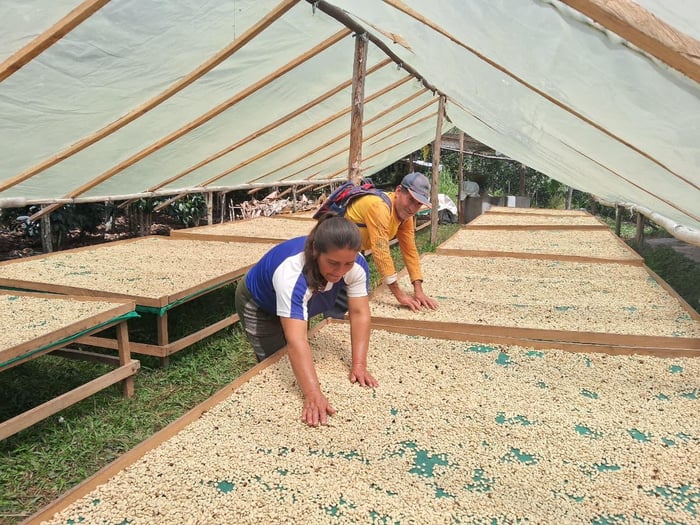
SH: You mentioned that you decided to test new practices on your own farms before scaling them. Can you tell us more about this?
ET: This was really important to us, because everything is about trust and long-term relationships. We didn’t want producers to feel like they were experimenting alone or assuming all the risk. By testing everything ourselves first, we could say, “We’ve already done this; we’ve already made the mistakes.”
That builds confidence. [They] know we’re not asking them to do something we wouldn’t do ourselves. That shared experience is the foundation of a long-term relationship.
SH: As more people joined the project, how did you maintain consistency?
ET: We were very clear from the beginning: this is a long-term process.
When producers see that we are committed year after year, providing seedlings, technical assistance, organic inputs, and follow-up, they understand that this is not a one-season project. It’s a relationship built over time.
SH: You've mentioned the importance of relationships multiple times. How do relationships factor into the broader impact you're seeing?
ET: Coffee quality and productivity don’t improve in isolation. They improve when there is continuity, trust, and shared goals.
The same applies to our relationships with buyers. Long-term commercial relationships give us the confidence to invest in soil health, education, and infrastructure. Without that stability, it would be very difficult to take these kinds of risks or think ten years ahead.
SH: Education also seems central to your model. How does that connect to long-term impact?
ET: Education is what sustains relationships. When producers understand why we do things, not just how, they become partners, not just suppliers.
Demonstration plots, farm visits, and producer exchanges reduce risk because learning is collective. Nobody is left alone to figure things out. That’s how trust grows, and that’s how long-term relationships are built, between producers, with Churupampa, and with buyers.
SH: What's next for Churupampa looking toward 2023?
ET: We want to diversify. No producer should depend on a single crop. We’re developing small-scale livestock models and other income alternatives that can also be replicated by producers.
Our goal is to ensure economic stability, environmental sustainability, and real long-term opportunities for the families who work with us.

.png "SH Logo")