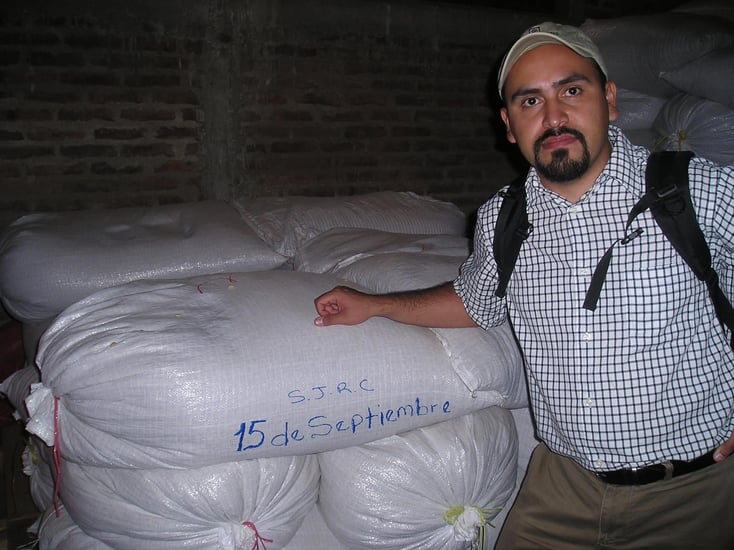
For Oscar Magro, coffee has always been part of his life. Even before it became his career.
Oscar was born in Oaxaca, Mexico and grew up in Pluma Hidalgo on his family's coffee farms, although his career initially took him in a completely different direction. He studied systems engineering and started his career in internet services before eventually moving into the coffee industry. The position, which originally involved supporting a coffee exporter, later grew into more than twenty years of service at Sustainable Harvest, where he helped develop the technology and systems that now support the company’s operations.
From laying the groundwork for Sustainable Harvest’s in-house Relationship Coffee Information Tracking System (RITS) to developing the Sustainable Harvest Portal, Oscar has always looked for ways to help our team work more efficiently, stay connected, and adapt to whatever comes our way.
We spoke with Oscar about his journey from Oaxaca’s coffee farms to IT, the evolution of RITS, and what still excites him about working in coffee. ________________________________________________
Sustainable Harvest (SH): Tell us a little about your connection to coffee and your family's history in Oaxaca.
Oscar Magro (OM): I was born in Oaxaca City, and my family is from there. On my father’s side, my great-grandfather and grandfather had coffee farms that they worked as a family. My grandfather also had another farm with my grandmother, and they were all in the Pluma Hidalgo area of Oaxaca.
One of those farms was eventually lost after the coffee market changed in Mexico. When the tariffs ended and INMECAFÉ (Mexico’s Coffee Institute, created in 1958 and closed in 1993) disappeared, prices fell, and my grandmother’s farm was lost.
My father didn’t become very involved in coffee because he saw how difficult it was for my grandfather. Some of my uncles continued producing, though, and I still remember tasting coffee from the farm that remained in the family.
I grew up with coffee. When I was a child, I would go to my grandfather’s house, and we would take several kilos of green coffee from the sack he always kept there. We would have it roasted, and that was the coffee we drank at home. So, as far back as I can remember, I’ve been drinking coffee.
SH: But coffee wasn't your original career path. How did you go from systems engineering to coffee?
OM: I studied systems engineering. Before I graduated from university, I did my internship at what was the first internet node in southeastern Mexico. After I graduated, I started working for an internet service provider in Oaxaca, the first in the state. I worked there for four years and eventually became the systems manager.
Then in 1995 I met Jorge Cuevas (when we were both taking French classes!) and in 1999, when I left the internet company, he told me he was starting a small coffee exporting company and needed someone to take care of the website and everything related to IT.
That’s how I started working with him.
SH: And how did you become involved in coffee quality and sourcing?
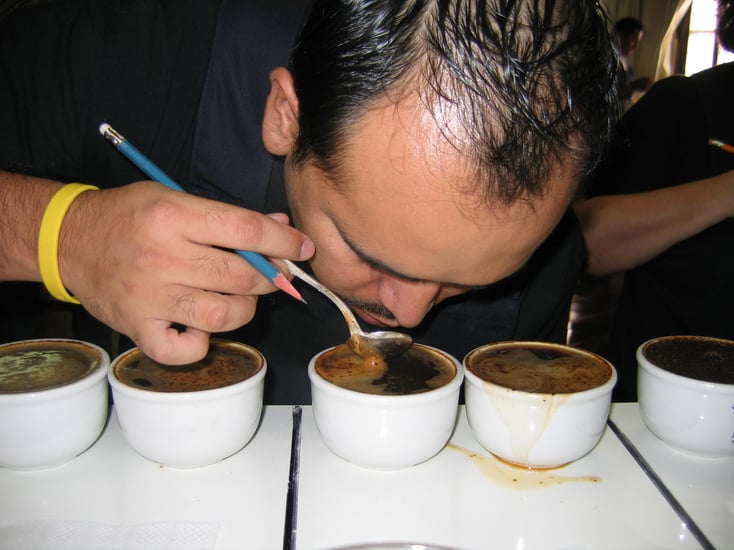
OM: Shortly after I joined Jorge’s company, he needed someone to take care of quality control. That’s when I became involved in coffee tasting.
I started learning how to cup coffee and began traveling with Jorge for sourcing. Around 2001, we started doing more sourcing trips.
Because in Mexico we basically only had work during half of the year, during the Mexican harvest, we also started doing sourcing trips for Sustainable Harvest during the rest of the year. That’s how I ended up traveling to places like Peru and Nicaragua.
So, little by little, I became involved in different parts of the coffee business.
SH: At the beginning, you weren't only doing IT, right?
OM: No. From around 2002 to 2008, I was probably only about 30% IT.
I was involved in logistics, quality control, sourcing, and marketing. I was doing a little bit of everything.
At the beginning, I also helped set up the cupping operation. I taught Chabe how to roast and prepare coffee for cupping, and she eventually took on more and more responsibilities in quality control.
SH: How did RITS come about?
OM: As our services expanded, we needed a system to streamline communication for our growing, multi-location team and manage contract information.
That was really the beginning of RITS.
RITS evolved as we added modules for billing, delivery orders, and other key operations.
When it was time to upgrade RITS, we hired a company to help, but when things didn’t go as planned, I took over the technical side and led development directly with a colleague.
That’s when I became fully dedicated to RITS.
SH: What role does RITS play in Sustainable Harvest today?
OM: The biggest advantage is that RITS was built for our needs and partners, focusing on efficiency.
It lets a small team do more with less. We control all imports and sales, and many functions are automated. The system is always improving as we find ways to make work easier.
RITS tracks contracts from creation with suppliers to the final invoice, managing logistics, quality control, finances, and accounts receivable along the way.
It also connects with apps like Tastify, letting different systems work together and making things easier for the team.
SH: Sustainable Harvest's Portal also creates visibility for producers, exporters and customers. How did that come about? And what makes the SH Portal different from other tools in the industry?
OM: RITS wasn’t originally built to support access for other users. But our partners (roasters, growers, exporters) would look at RITS and ask, “Why can’t I see this? Why can’t I see my contracts?”
So, we decided to build another front end that connects directly with RITS. It can provide specific contract information in real time and also manage inventory information.
I think the biggest difference is that we focus on both roasters and suppliers. Other portals are usually designed primarily for roasters, but we see producers, exporters, and roasters as our partners. We want all of them to have direct access to the information that’s relevant to them.
SH: How does the portal make things easier for our partners?
OM: One of the biggest benefits is that roasters and suppliers can take care of many tasks directly through the portal, without having to rely on our team for every step. For example, roasters can submit releases, download transaction certificates and producer certificates for audits, access certification information, request coffee and samples, approve samples and find information and photos for marketing purposes.
This also saves time for our traffic and certifications teams, allowing them to focus on strategic workflows while our partners can access the information and complete tasks when they need to.
SH: You've been working with Sustainable Harvest for more than 20 years. What has been the most rewarding part of that experience?
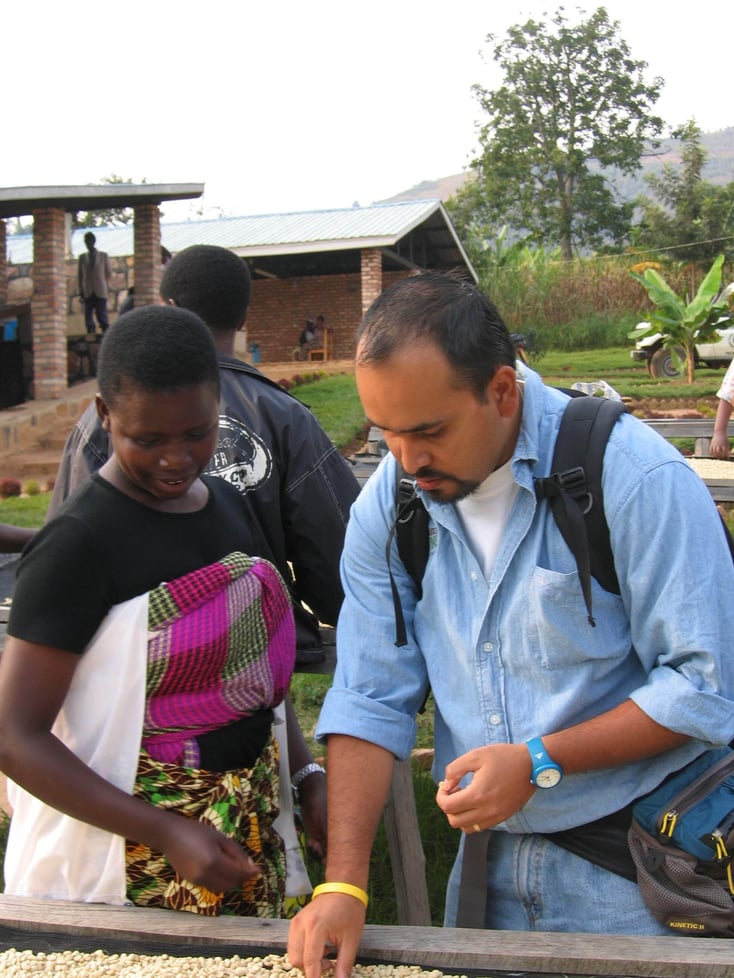
OM: I think it has been seeing the evolution of producer organizations.
I remember the first time I went to Peru. Many organizations were exporting through large exporters that also controlled quality and many other parts of the business.
Now, seeing those same organizations exporting directly, doing their own quality control, managing their own businesses end-to-end, and becoming much more sophisticated has been very rewarding.
They travel all over the world promoting their coffee. Many of them have developed tremendously.
I feel like Sustainable Harvest may have contributed a little bit to that development. A lot of the projects we worked on were designed to help organizations improve their operations, quality control, risk management, and other areas.
Being able to see that evolution over time is very gratifying.
SH: What do you think distinguishes Sustainable Harvest from other companies in the coffee industry?
OM: I think it’s the idea that it’s not just about benefiting ourselves. If we benefit the entire supply chain, everyone can be better off: The producer has a good income, we have a healthy business, and the roaster is happy because they receive good quality at a reasonable price.
I think transparency is an important part of that – being transparent about pricing and not trying to obscure the supply chain just so one side can benefit.
At the same time, we also need to be financially healthy ourselves. We need to have good finances and show our suppliers that it’s possible for everyone to benefit and to still have a healthy business. That’s how we can continue doing what has always been our mission.
SH: What is the biggest challenge in your role today?
OM: I think the biggest challenge is always efficiency. How can we improve our systems? How can we do a task in less time, with fewer steps, or make it something that can run automatically?
How can we do more with less?
That’s what keeps RITS and the Portal moving. There will always be something new. The system has to keep improving and adapting – to changes in tariffs, to the pandemic, to changes in the business, and to new needs.
We’re also putting more emphasis on metrics and indicators so that we can understand where we’re doing well, where we need to make changes, and where problems might be.
SH: What are you focused on now?
OM: My role has recently shifted back to being more focused on Sustainable Harvest after spending some time on other Sucafina projects. Now I’m more focused on further developing and improving RITS and the Portal.
SH: After all these years, what keeps you excited about working in coffee?
OM: What excites me most is trying to incorporate new things into our systems and processes.
Today, for example, there is AI. There are always new technologies that can help us become more efficient and effective.
Because we’re a small company, we can take some risks, experiment, and try new technologies. I think that’s what excites me the most.
And I’m doing it for coffee. I don’t think I would have the same motivation to do this for just any company. That combination – the coffee industry and the constant opportunity to learn, experiment, and improve – is what keeps me interested.
SH: After more than two decades in coffee, how has your taste changed?
OM: My taste has changed a lot.
At first, I really liked coffees from Oaxaca, especially Pluma coffees with those panela flavors.
Then, after my first trip to Nicaragua, I became interested in coffees with flavors like plum and peach. For a while, Ethiopian coffees were also favorites of mine, especially Yirgacheffe. I really liked those fruity flavors.
Over time, I developed a taste for naturals. I still like them a lot.
Today, though, for health reasons, I drink decaf. So I try to find a good-quality decaf. The process I like most right now is the sugarcane process because I think it preserves more of the coffee’s flavor.
SH: And how do you prepare your coffee at home?
OM: I prepare my decaf in my xBLOOM.
I’ve had that coffee maker for more than two years now. I mostly do pour-over, although sometimes I use the espresso machine.